 Therapy by Alice
Price Increase after the New year
Posted on December 8, 2022 Leave a Comment
Everything costs more than it used to so unfortunately I have to raise prices to match the rest of the world. But I will promise to give the best service and massage I possibly can and you will leave my office feeling fantastic. Each item will be $5 more and the fully updated price list will be on my booking site at
Adagio Massage and Music Therapy
And always remember…at Adagio Massage and Perryman Septic Service we will massage the crap out of you.

Pushing the Limits
Posted on November 23, 2022 Leave a Comment
https://www.cbsnews.com/news/jeff-johnny-agar-father-son-ironman-triathlon-cerebral-palsy/
Video above…totally worth seeing.
Jeff and Johnny Agar are not your typical athletes. But with more than 200 races under their belts, including a full Ironman race, the father-son duo are overcoming the odds and redefining what it means to be champions.
Johnny, 28, has cerebral palsy, a muscle disorder that makes it difficult to walk and talk. So Jeff, at 59, takes on triathlons — an individual sport — for two people, totaling 400 pounds with their equipment.
When Jeff swims, he pulls Johnny. When Jeff runs, he pushes Johnny. And when Jeff bikes, he hauls his son.
Their bond is as strong as iron — tempered by love.
“I mean, I’m not a fan of swimming, biking or running, which is perfect for triathlon,” Jeff told CBS News, laughing. “This probably wouldn’t be in the top 100 things I would select to do. … I’m not doing it because I love it. This is Johnny’s dream and I’m giving him the legs and the power to do it.”
“I think we’re just trying to show him: You can’t let obstacles stand in your way,” Jeff said.
Jeff and his wife, Becky, found out their son had cerebral palsy when he was just three weeks old and were devastated by his diagnosis.
“It took a couple seconds to figure out: this is a totally different world for us. This is not going to be the typical type of thing,” Jeff told CBS News.
“I remember asking him one day, I said, ‘You know, what if he can’t play catch with you? What does that mean to you?’ And he said, ‘You know, I just love him. It doesn’t matter what he can and can’t do,'” Becky said.
“It was at that point I though, ‘Gosh, I got the right guy,'” she added.
Together, the Agars have completed more than 200 races across nine states over the past 14 years.
For me, it’s a tremendous blessing,” Johnny said of his father helping him compete. “I’m able to express my desires through him and he understands that. … You know, I saw Dad pushing himself to get me across the line. And I said to myself, this is ridiculous. I am capable of doing more.”
So, two months ago, they went after a goal they’d attempted five times before: finishing the ultimate endurance event, a full Ironman race. It was held in Maryland, where the father and son had to complete a 2.4-mile swim, 112-mile bike ride and 26.2-mile run. They trekked 140 miles in under 17 hours.
For the first time, they did it, with just five minutes to spare. Johnny took it upon himself to cross the finish line for his team.
“Walking in races was my way of telling dad, ‘Okay, I’m not just going to say thank you anymore, I’m going to actually put words into action,'” Johhny said.
He said being able to inspire someone else gives his challenges purpose.
“Even though he got him the 140 miles, he’ll always be hiding behind Johnny,” Becky said of her husband. “He doesn’t want to be announced as an Ironman. It’s Johnny’s moment. And it’s the most beautiful thing to me.”
So what’s next for team Agar? They’re doubling down in hopes of securing a spot at the Ironman World Championship next year in Kailua-Kona, Hawaii.
“It’s considered the most brutal one-day endurance event on the planet,” Jeff said. “You get 17 hours. And we would probably use every minute of it. For sure.”
They competed in the race back in 2016 but weren’t able to finish the bike portion in the time allowed.
“Sometimes you win, sometimes you learn,” Johnny said.
“It’s not about the medal for me. It’s not about the fame. It’s about doing it as a team,” Johnny said.
Liz Langley Ted talk
Posted on September 4, 2022 Leave a Comment
I find the singer very inspirational
Booking now
Posted on August 15, 2022 Leave a Comment
https://pocketsuite.io/link/alice-perryman
This is my booking link. I’ll be available after Wednesday this week and all next week then out of town until Labor Day.
Milo’s Eyes
Posted on August 11, 2022 Leave a Comment
Of course I already bought the book
https://www.cbsnews.com/video/blind-equestrian-on-defying-the-odds/
check out this story.
Addressing Postural Plasticity-reprinted from Erik Dalton
Posted on July 29, 2022 Leave a Comment
Digital Dementia is a term coined by neuroscientist Manfred Spitzer to describe a condition caused by digital technology overuse that results in a breakdown of cognitive abilities. When most of us consider the term cognition we think of our ability to think, problem solve, or just do our work, but how many of us relate it to posture? Poor posture is not a cause as much as it is a symptom. Essentially, it is dysfunction of various systems in the body that are either over or under functioning. In most bodywork circles, we think of faulty posture as a ‘tissue issue’ and, in many cases problems do arise from strained or overused connective tissues and joints, but what about visual or balance (vestibular) disorders that may be compromising of the brain’s sorting and switching stations?
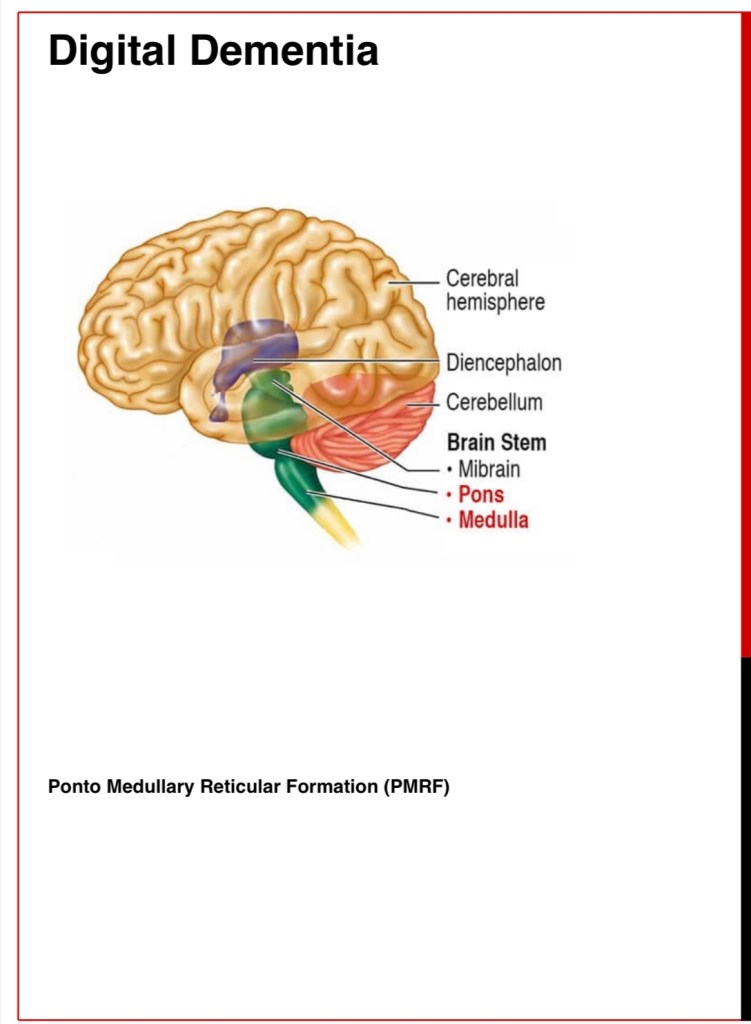
Digital Dementia
The PMRF is a dynamic relay station located in the brainstem at the pontomedullary junction where pons meets the medulla. It is considered the epicenter for postural control (Image 1.). The PMRF houses eight cranial nerves that carry out vital motor and sensory functions including eye-ear coordination that aids in head righting reflexes and balanced gait. When functioning properly, the PMRF inhibits cervicothoracic flexion, which, in turn, effectively resists gravitational exposure. Those clients with PMRF disorders may present with an Upper Cross Syndrome pattern, i.e., forward jutted chin, internally rotated arms, protracted shoulder girdle, and t-spine hyperkyphosis. Each day these bodies battle gravity and in the absence of experienced manual, movement and brain-based therapy, usually end up on the losing end.
Hours sitting staring at screens, lack of exercise, and poor body biomechanics all contribute to the symptom of poor posture, and may lead to other conditions such as lack of focus, visual disturbances, depression, poor balance, protective muscle guarding and more. When performing a postural assessment as part of a client’s intake exam, I’m not only looking at tissue issues, but more importantly, what the nervous system is doing with this information. For example, I may include proprioceptive challenges such as one-legged standing to assess for vestibular (balance) dysfunction, gaze stabilization exercises for visual disturbances or the Romberg (sway) Test for cerebellar weakness. Sensory impulses originating in the neck and ankles are particularly important. Proprioceptive input from the neck indicate the direction in which the head is turned and cues from the ankles indicate the body’s movement or sway relative to the ground.
As sensory integration takes place through good bodywork and corrective proprioceptive exercises, the brain stem transmits impulses to the muscles that control movements of the eyes, head and neck, trunk, and legs, thus allowing a person to both maintain balance and have clear vision while moving. Of course, there are multiple neurological systems that contribute to optimal posture. Our goal is synergistic integration of these systems to normalize and restore flexor/extensor synergy and postural stabilization during dynamic movement.
Connective tissue and yin yoga
Posted on July 18, 2022 Leave a Comment
Three types of connective tissue as follows.
1. Ligaments—bind bone to bone
2 Tendons – bind muscle to bone
3 Fascia-fibrous material that binds the whole body together. The webbing of the body.
These connective tissue don’t respond well to heat building types of workouts. The respond better to slow workouts.
 Therapy by Alice