 Therapy by Alice
New Employment Opportunity
Posted on December 31, 2025 Leave a Comment
While I am continuing to market to veterans so I can see them as part of their health care plan, I continue to struggle with getting the word out to those potential clients. Michael, my husband, is retiring from his septic business in the next few weeks, and I decided that I should pick up some more hours in the new year.
I will be starting at Ironclad Bodywork in Copperas Cove, TX in January. I will be working on Tuesday 2-8pm, Thursdays 9-2pm and the Sundays that I am in town which is about 50%. I’m really looking forward to the new opportunity.

Changes are Coming
Posted on December 12, 2025 Leave a Comment
Over the past several years, my work has continued to grow and evolve. As I’ve listened more closely to my clients, my own nervous system, and the work that feels most sustainable and meaningful, I’ve made some thoughtful changes to how Therapy by Alice is structured and offered.
Therapy by Alice now clearly includes three focused areas of care:
massage therapy, interactive music therapy, and equine myofascial bodywork. While these services may look different on the surface, they are all grounded in the same philosophy—trauma-informed, non-force work that supports regulation, resilience, and meaningful change.
My massage therapy practice is now centered on therapeutic, problem-oriented bodywork for adults and veterans who want to work through physical tension, pain, or emotional patterns held in the body. I no longer offer spa-style or relaxation-only massage. This shift allows me to provide more focused, engaged care for clients seeking deeper, intentional work.
My music therapy services continue to focus on interactive, relational music-making for children and adults with developmental disabilities. This work emphasizes engagement, co-regulation, communication, and connection through shared musical experiences.
I am also expanding my equine myofascial and nervous-system bodywork, offering non-force, trauma-informed care for horses impacted by stress, tension, or trauma. When appropriate, I offer gentle conversation and awareness for the human partner, recognizing that horses and humans often influence one another’s nervous systems.
At this time, Therapy by Alice is based in Gatesville, Texas, offering services through mobile, barn-based, and professional office settings as available. Availability and travel vary by service type.
These changes reflect a commitment to clarity, sustainability, and depth of care. They allow me to show up fully for the clients and animals I work with, while staying aligned with the values that have guided my work for many years.
If you have questions about whether my services are a good fit for you or your horse, I invite you to reach out. I’m always happy to have a conversation.
Thank you for being part of this next chapter of Therapy by Alice.
— Alice
New Services offered
Posted on November 11, 2025 Leave a Comment
🌿 Music & Massage Therapy with Alice – Serving Gatesville, Purmela & Beyond
Hi, I’m Alice—a dual-certified Music Therapist and Massage Therapist with years of experience supporting seniors, individuals with disabilities, and those receiving hospice care. I’ve transitioned from a traditional office in Evant to a more personal in-home model, offering sessions at my home office in Purmela, TX, or traveling to yours.
🎵 Music Therapy
Music has the power to heal, connect, and comfort. My sessions often include:
- Exploring music from a client’s youth
- Singing, listening, and reminiscing
- Gentle companionship through sound
This approach is especially meaningful for homebound seniors and those living with dementia. Sessions typically last 30–60 minutes, tailored to each person’s needs.
💆 Massage Therapy
Massage can ease pain, improve circulation, and offer emotional relief. I specialize in:
- Seniors and homebound individuals
- Clients with physical or developmental disabilities (including CLASS program participants)
- Equine massage for horses, including cranial sacral and myofascial techniques
Discounts available for multiple horses at the same barn.
🏡 Where I Work
- My home office in Purmela
- Client homes across the Gatesville area
- Senior centers, activity centers, and nursing homes
- Even children’s birthday parties as a musical entertainer!
💬 Payment & Scheduling
Rates are flexible and based on:
- Session length
- Travel distance
- Family or client needs
Let’s talk about what works best for you.

Intrinsic Muscles of the hand
Posted on April 1, 2025 Leave a Comment
Reprint from ABMP Bodywork magazine
https://www.abmp.com/massage-and-bodywork-magazine/intrinsic-muscles-hand
A client of mine had pain and dysfunction in one of her hand intrinsics—the first palmar interosseous (Image 10B)—which was functionally impairing her life. In my 40 years of practice, she is the only client for whom detailed knowledge of this muscle mattered, but for her, it was 100 percent of the cause of her problem, and I am so grateful I was sufficiently conversant with this muscle to help her.
“Keri” was a yoga instructor who, one day without any specific precipitating event, started to experience pain in the palm of her right hand. Over a few days, the pain increased to the point that she could not place any weight-bearing pressure through her hand. As a result, she couldn’t perform many yoga asanas (downward dog, for example), and therefore, was unable to teach many of her classes. Given that Keri had rent, car, electric, and food bills to pay, this condition was clearly impacting her life.

She first went to a massage therapist who palpated her shoulders (cervicothoracic region), and finding myofascial trigger points, informed Keri that the trigger points were referring pain into her hand, so they were the source of her problem. Keri went to the massage therapist for a few massages. Her shoulders felt better, but her hand pain did not improve.
Keri then went to a chiropractic physician who palpated the motion of her cervical spinal joints. Finding joint dysfunction hypomobilities, the chiropractor told Keri that pinched nerves in her neck were causing the pain in her hand. She had a few treatments with the chiropractor who adjusted her neck each session. Her neck felt better, but her hand pain remained unchanged.
Keri then went to an orthopedic surgeon who specialized in the wrist and hand. He took an X-ray and diagnosed her as having excessive space in the saddle joint of her thumb. He told her that this caused hypermobility of her thumb, which was causing the pain in her hand. He recommended she have an operation to tighten the ligaments of the joint. Keri did not proceed with this.
At this point in time, Keri happened to be at an anatomy of yoga workshop in New York City. When she described her problem to the instructor, he told her that the person who had written the text (me) they were using in the class was nearby in Connecticut.
Keri made an appointment right away. She presented to me with pain in her palm that was located between her second and third metacarpals, closer in against the second metacarpal. Given that three professionals had all missed the source of her problem, and the gravity of the situation for her, I felt it important to perform an extremely thorough history and physical exam. I spent two hours checking everything, from the possibility of cervical disc conditions and joint dysfunction in her neck to thoracic outlet syndromes, pronator teres syndrome, carpal tunnel syndrome, and all upper-extremity musculature in the back, neck, shoulders, arm, and forearm that might be causing myofascial trigger point referral pain into her hand. Every orthopedic and palpation examination procedure came out negative.
I then turned my attention to her hand, where she was experiencing the actual pain. I palpated each and every intrinsic muscle of the hand. And at the location where she felt the pain, I found her first palmar interosseous to be tight. The palpation protocol was done by having her squeeze a pen or highlighter between her index and middle fingers, thereby engaging index finger adduction musculature, namely the first palmar interosseous muscle (Image 1).1 Engagement of the first palmar interosseous could clearly be felt, and upon digital pressure into this muscle, the characteristic pain that Keri had been experiencing was reproduced.

It was as simple as that. A tight palmar interosseous muscle was the source of her pain. Armed with a specific target for treatment, I employed heat, massage, and stretching to the first palmar interosseous, which, after only a few sessions, was successful in removing all the pain and dysfunction.
What lessons can be learned from this case study? While I don’t excuse the chiropractic and orthopedic physicians for having misdiagnosed Keri and recommending care that was not needed for her condition, I can understand it. There is an old saying: If all you have is a hammer, everything looks like a nail. Surgeons generally like to operate; and chiropractors generally like to adjust joints. But I find it extremely disconcerting that the massage therapist, who should be a myofascial expert, missed something so simple. The client reported pain in a specific spot in her palm, and the therapist never even ventured there. Might this be because the massage therapist was not comfortable with her knowledge of the intrinsic musculature of the hand so she avoided focusing her attention on the palm?
Either way, I believe this case study illustrates the importance of learning all the muscles in the body, including those small hand intrinsics that perhaps we have avoided learning. Who knows, it might make all the difference in the future for a client who presents with pain in their hand or perhaps in some other somewhat obscure muscle of the body.
The Basics of the Intrinsics
In most massage therapy school curricula, there isn’t enough time in the muscle anatomy and physiology classes to learn all the muscles of the body. Usually, the muscles that are skipped are the smaller muscles, including the intrinsic muscles of the hand.
Intrinsic hand muscles are those that are wholly located within the hand. In other words, their proximal attachments (origins), bellies, and their distal attachments (insertions) are all located within the hand. These muscles can be contrasted with the hand’s extrinsic muscles that have their proximal attachments in the arm or forearm, their bellies in the forearm, and then travel distally with their tendons crossing the wrist to attach into the hand. These extrinsic muscles include the muscles of the wrist flexor and extensor groups, the long finger flexors and extensors, and the long muscles of the thumb (Table 1, Images 2 and 3).

Most massage therapists have learned and are fairly comfortable with the hand’s extrinsic muscles. However, in my experience teaching continuing education workshops across the US and internationally, most therapists, whether they are newly out of school or have been practicing for years, are not conversant with the intrinsic muscles of the hand.2

This is unfortunate, because although these muscles might not exhibit pain and dysfunction as often as some of the more well-known muscles of the upper extremity (e.g., rotator cuff, deltoid), there are times when clients present with issues with these hand intrinsics. And given that massage therapy is one of the few professions that focuses on soft tissues, it would be hoped that a massage therapist could help these clients.

So, how difficult is it to truly learn the intrinsic muscles of the hand? Surprisingly, it’s quite easy, especially if we approach learning these muscles in five simple steps. If you have always wanted to learn the intrinsic muscles of the hand but have never felt it was the right time or have never quite found the right approach, consider this your invitation. Here are the five steps we will take:
- Overview of the intrinsic groups
- Compare the muscles of the thenar and hypothenar groups
- Identify muscles of the central compartment group
- Learn the actions of the intrinsic muscles
- Learn the attachments of the intrinsic muscles
1. Overview of the Intrinsic Groups
There are essentially three groups of intrinsic muscles in the hand: thenar eminence group, hypothenar eminence group, and central compartment group. The muscles of the thenar eminence are muscles of the thumb (pollicis) and form the eminence of tissue on the radial/thumb side of the palm. The muscles of the hypothenar eminence are muscles of the little finger (digiti minimi) and form the eminence of tissue on the ulnar/little-finger side of the palm. The muscles of the central compartment are between the thenar and hypothenar groups—in other words, located centrally, as the name implies (Image 4).

2. Comparing Muscles of the Thenar and Hypothenar Groups
There are three muscles in the thenar group, all of which have pollicis (Latin for “thumb”) in their name (Image 5).

Similarly, there are three muscles in the hypothenar group, all of which have digiti minimi (Latin for “little finger”) in their name (Image 6). Further, these three muscles in each group are named abductor, flexor, and opponens.

For the thenar eminence thumb group, the muscles are the abductor pollicis brevis, flexor pollicis brevis, and opponens pollicis. Note that the word brevis is included in the abductor and flexor muscles to distinguish them from the same-named extrinsic longus thumb muscles from the forearm; there is no longus opponens, so brevis is not necessary for its name.
For the hypothenar eminence, little-finger group, the muscles are the abductor digiti minimi manus, flexor digiti minimi manus, and opponens digiti minimi. Here, note that the word manus is included to distinguish them from the same-named muscles for the little toe of the foot (digiti minimi pedis muscles). It is a central tenant of anatomy nomenclature that words are added into the name of a muscle only when needed to distinguish that muscle from another similar muscle of the body. In our case here, brevis versus longus, manus versus pedis. So, we have abductor, flexor, and opponens pollicis muscles; and abductor, flexor, and opponens digiti minimi muscles respectively in the thenar and hypothenar groups.
3. Muscles of the Central Compartment Group
The central compartment group has one pollicis muscle and three individual muscle groups. The pollicis muscle is the adductor pollicis (yes, of the thumb, but its belly is in the central compartment, hence its inclusion in the central compartment group). The three individual muscle groups comprise the four lumbrical manus muscles (manus to differentiate them from the lumbrical pedis muscles of the foot), the three palmar interossei, and the four dorsal interossei manus (Image 7).

Note: There is one odd-duck intrinsic hand muscle I have left out of this big-picture approach—the palmaris brevis (Image 8). The palmaris brevis overlies the hypothenar eminence musculature but is often not included in the hypothenar group because it is not a muscle of the little finger (and including it in the hypothenar group would ruin the beautiful symmetry of the thenar/hypothenar comparison).

4. The Actions of the Intrinsics
Generally, for any muscle that we learn, we need to learn its name, its attachments, and its actions (and perhaps nerve innervation; see “Nerve Innervations of the Intrinsics”). Learning the actions of the intrinsics is actually quite easy because most of their names tell us their actions (or at least the major action).
In the thenar group, the abductor pollicis brevis abducts the thumb, the flexor pollicis brevis flexes the thumb, and the opponens pollicis opposes the thumb. Similarly, in the hypothenar group, the abductor digiti minimi manus abducts the little finger, the flexor digiti minimi manus flexes the little finger, and the opponens digiti minimi opposes the little finger. How wonderful!
The actions of the central compartment are not quite as self-evident. The adductor pollicis certainly adducts the thumb, but the others have actions that are not stated in their names. However, there are a few principles here that can help. The lumbricals flex fingers 2–5 (index to little fingers) at the metacarpophalangeal joints but extend those fingers at the interphalangeal joints. One can think of the letter L having the same 90-degree hinged angle that the lumbricals create at the metacarpophalangeal joints of the fingers with these actions (Image 9).

For the interossei, the dorsal interossei manus all abduct the fingers to which they attach, and the palmar interossei all adduct the fingers to which they attach (Images 10A and 10B). (Think DAB PAD: Dorsals ABduct; Palmars ADduct.) Knowing the specific fingers to which they attach can be figured out (see “Interossei”). And the palmaris brevis, attaching into the palmar fascia, tenses the palmar fascia as its function; this can help to increase our grip strength.


5. The Attachments of the Intrinsics
Most often, when learning a muscle, we first learn its attachments, because knowing the attachments allows us to figure out its action(s). After all, a muscle is just a pulling machine, so knowing its attachments gives us its line of pull, hence its actions. But with the hand intrinsics, because of the organization into thenar and hypothenar groups, and because the names so often indicate the actions, we began with the actions and have left the attachments until now.
Stepping back from the big picture, we have already stated there is an abductor, flexor, and opponens in both the thenar and hypothenar groups. But of further help is the fact that these three muscles in each group are arranged, from superficial to deep, in alphabetical order: from Abductor to Flexor to Opponens (Images 5 and 6).
Now, looking at the actual attachments, the principal proximal attachments of the thenar and hypothenar muscles are onto carpal bones. The thenar group muscles attach onto the tubercles of the scaphoid and trapezium; the hypothenar group muscles attach onto the pisiform and hook of the hamate. The distal attachments of the thenar muscles are onto the thumb; and the distal attachments of the hypothenar muscles are onto the little finger. This could be examined in greater detail (e.g., additional fascial attachments proximally, and metacarpal vs. phalangeal attachments distally), but this is a good landing place as our primer for these muscles.
In the central compartment, the adductor pollicis and the palmar and dorsal interossei all attach proximally onto metacarpals and distally onto the phalanges of their respective fingers (see Image 6, Image 9, and “Interossei”). This leaves the lumbricals, which attach proximally into the flexor digitorum profundus tendons and distally into the extensor digitorum muscle tendons (see Image 6); and the palmaris brevis, which, as stated, attaches into the palmar fascia (see Image 7).
Great Knowledge to Have
In conclusion, I believe I have laid out a simple five-step approach that allows us to understand and have a certain mastery of the intrinsic musculature of the hand. If you already had some familiarity with the intrinsic musculature, hopefully this has helped to organize them into a clear context. If this is your first exposure to the hand intrinsics, then perhaps you might want to read through this another time or two until it all makes intuitive sense.
How important is this knowledge? That depends on the clients who come into your practice. The case study that began this article is a perfect example. Perhaps we will not need to know the specific knowledge of the hand intrinsics for most of our clients, but for some clients that present to us, this knowledge could prove
to be invaluable.
Notes
1. Because this procedure also requires middle-finger radial abduction, the second dorsal interosseous manus muscle also engages. But this was not of concern because the dorsal interosseous musculature is on the dorsal side of the hand, so it would not cause confusion with palpation into the palm.
2. This same discussion could be had regarding the intrinsic muscles of the foot in the lower extremity.
A Deeper Dive—Nerve Innervations of the Intrinsics
Learning the innervation of the hand intrinsics is extremely easy. We begin with the big picture, then look at the couple of exceptions to this organization.
The Overall
- The thenar group is innervated by the median nerve.
- The hypothenar and central compartment groups are innervated by the ulnar nerve.
The Exceptions
- The ulnar nerve contributes to the innervation of the flexor pollicis brevis and opponens pollicis.
- Lumbricals manus No. 1 and No. 2 are innervated by the median nerve (not the ulnar nerve).
A Deeper Dive—Interossei
Learning which fingers the palmar and dorsal interossei attach into does not have to be memorized; it can be reasoned out. Keeping in mind that the dorsals abduct and the palmars adduct, the specific fingers can be ascertained.
The three palmar interossei attach into fingers 2, 4, and 5 (index, ring, and little), because the thumb (finger 1) always gets its own muscles; and the middle finger, finger 3, cannot adduct, it only abducts (radial and ulnar abduction), so there is no palmar interosseous into it. This leaves fingers 2, 4, and 5 each needing a palmar interosseous to adduct it.
The four dorsal interossei attach into fingers 2, 3, and 4 (index, middle, and ring). Why? Because the thumb always gets its own muscles; and the little finger has its own abductor in the hypothenar group (abductor digiti minimi manus), which leaves fingers 2, 3, and 4. And because the middle finger (finger 3) can abduct in two directions (ulnar and radial) there are two dorsal interossei onto that finger, totaling four dorsal interossei.
Of course, all this is predicated on understanding the kinesiology of frontal-plane abduction and adduction of the fingers, the essence of which is that abduction and adduction of fingers 2–5 is relative to an axis—an imaginary line that goes through the center of the middle finger—when the middle finger is in anatomic position.
So dorsal interossei attach onto their respective fingers on the sides of the proximal phalanges that are away from the reference line; and palmar interossei attach onto the sides of the proximal phalanges that are oriented toward the reference line.
Tags #anatomy #wrist #hands
Super Power
Posted on March 24, 2025 Leave a Comment
What’s a secret skill or ability you have or wish you had?
I am very good at remembering people‘s name. I know that sounds like a silly skill in some ways, but it tends to make people feel appreciated when you recall their name. I frequently wish I had a superpower of making lots of money, but that does not seem to be where my talent lives.
I also have the skill of helping people to feel better both physically and emotionally. I wish that more people knew how I can help them with my Massage Therapy business or with Musictherapy and would call me for a quick. I would really love to be more available for people, but I’m not sure how else to get the word out.
Where you will find me
Posted on March 22, 2025 Leave a Comment

This is a view of the Paluxy River in Glen Rose, TX. In two weeks, my husband, Michael and I will be hosting a NATRC competition here. I’m the secretary I wanted to ride the ride, but I am starting to doubt myself a little. Being in ride management is a big responsibility, but I know that Mike will rise to the occasion. He is a lot calmer than I am and better able to handle last-minute stress. This is a stretch of the river we will ride down. Just past the last boulder is an uphill to a beautiful trail through the woods and along the Brazos river.
In other news, I have been accepted by Tri-West as a provider of Massage to local Veterans. As they go to the doctor and have a RX for massage, please request me. I’m so much closer to vets in Lampasas, Hamilton, Gatesville, and Evant than having to drive to Killeen.
google is hiding my business
Posted on March 11, 2025 Leave a Comment
For no apparent reason Google is hiding my business:Adagio Massage and wellness at 142 US Highway 281, Evant, TX 76525. They claim I have Deceptive Marketing practices. I have sent in a video showing I’m the owner of this business and here is what I get back.
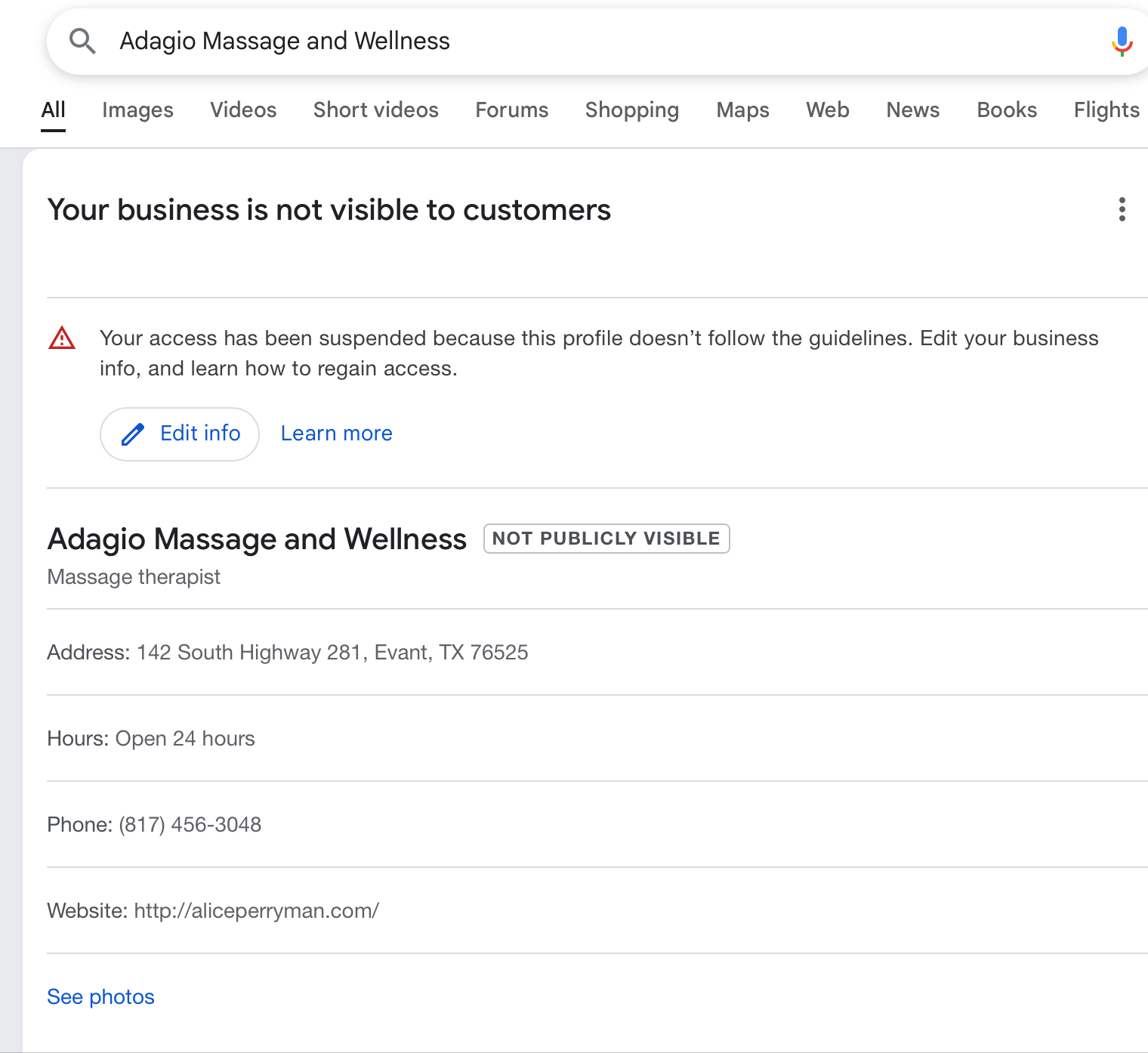
I did the things it said to prove I’m real and I went through a protest that was denied. I have gotten a PO BOX connected to my address so they can send actual mail. I have gone on Google map to correct the address details. Maybe if other people also do this it will help? I’m so confused. I’m on yelp and I show up because of this blog but I can’t figure out what they want from me.
Suggestions?
New protocols for injuries
Posted on March 8, 2025 Leave a Comment
https://www.physio-network.com/blog/ice-for-acute-injury/?


I’m always telling people to ice their sore muscles. While this article is about acute injury, I thought it was interesting enough to repost. Check out the link to read the whole article.
How is failure actually a success
Posted on March 7, 2025 Leave a Comment
How has a failure, or apparent failure, set you up for later success?
I would say that looking back and finding bad choices I have made has actually brought me to the place I am and the life I am living. I look back and think of the things I wanted to do for careers, where I wanted to live etc, that would have led me another place and I would not be enjoying my husband or my horses like I am today. Every choice has the opportunity for success or failure but the failure doesn’t last forever.
Erik Dalton tipsy
Posted on March 5, 2025 Leave a Comment
https://www.facebook.com/groups/erikdalton/permalink/3830459473872521/?
Low Back Z-Joint Pain: Addressing Facet Joint Syndrome
In this week’s Technique Tuesday newsletter, blog post, and demonstration video we discuss low back pain related to the mechanical wear and tear of the zygapophyseal joints (commonly called facet joints).
An injury, repetitive stress, obesity, weak posture, and aging articular cartilage may change the way Z-joints align and glide on one another leading to an inflammatory response. The brain signals “danger” triggering protective guarding.
In acute cases, Z-joint symptoms localize to one side of the back adjacent to the spine. In chronic cases, diffuse pain spreads into the buttocks, groin, or down the limb.
Learn the Z-Joint Pain Provocation Test, the Sphinx Hyperextension Test, and Kemp’s Test, then practice two techniques to address Z-joint pain.
Massage therapists, bodyworkers, physical therapists and manual therapists read the blog and watch the demonstration video to learn the Z-Joint Pain Provocation Test, the Sphinx Hyperextension Test, and Kemp’s Test. Then, practice two techniques to address Z-joint pain. When you sign up for the Technique Tuesday newsletter you get a treasure trove of MAT resources without subscription fees. Visit blog.erikdalton.com.
 Therapy by Alice