 Therapy by Alice
One Prairie Outpost
Posted on June 24, 2020 1 Comment
I have had this song in my head for the last day or so. I’m not really sure why but I thought I would post it. I’d love to hear your thoughts about it.
One of the things I do in music therapy is to discuss words and music, often referred to as song analysis or lyric analysis. What do you think of when you hear this song? What do you think they are singing about? There are no right or wrong answers. Please post comments.
About the group: Carbon Leaf is my absolutely favorite band. My daughter loves them too and we have been to several concerts. We are concerned they won’t be able to come this year.
Singing play songs and lullabies: Investigating the subjective contributions to maternal attachment constructs
Posted on June 18, 2020 Leave a Comment
Alison Creighton RMT, Michael Atherton, Christine Kitamura PhD
Abstract
The aim of this study was to examine how the experience of singing play songs and lullabies contributes to early mother-infant attachment. A total of twenty-three healthy mother-infant dyads were recruited. Twelve were interviewed about their subjective experience of singing interactions. Eleven were interviewed about their subjective experience of non-singing play interactions. The interviews were transcribed and analysed using an adapted phenomenologically inspired analysis process (Grocke, 1999) then compared to Condon and Corkindale’s (1998) four maternal attachment constructs or domains including: (1) pleasure in proximity, (2) tolerance/acceptance, (3) need gratification and protection, and (4) knowledge acquisition. The findings reveal that the mothers’ experience of singing interactions primarily impacted the pleasure in proximity, need gratification and tolerance/acceptance constructs. The mothers’ experience of non-singing interactions primarily impacted the pleasure in proximity, need gratification and knowledge acquisition constructs. The experience of singing was distinctly different from the experience of non-singing interactions in multiple ways. The findings reveal that singing facilitated a flow of interconnections between positive mental and emotional states. Furthermore, it appears that the therapeutic potential of singing to impact attachment lies within the positivity and flow of the mothers’ intrinsic experience of singing. Overall, the findings expand current understanding of how singing play songs and lullabies may contribute positively to maternal constructs of attachment in the first year of life.
Full Article below
Exciting Day
Posted on June 18, 2020 Leave a Comment
I got the “keys” to my new office today. I’m so excited about what will be coming in the next few months to Adagio Massage and Music Therapy. I already have my first appointment scheduled and over the next few months I will be in my office most Monday, Wednesdays, Fridays and some Saturdays. I hope to be offering music therapy birth music classes as people prepare for their baby arrivals and I will be doing pre-natal massage as well. So much happening. I feel like it’s a start of a really exciting time. Below I have attached my brochure for birth music therapy services. I have some pro bono and/or sliding scale spots open for new clients.

Opening Day June 17
Posted on June 5, 2020 1 Comment
It’s official! I will be starting to see Massage clients in Burnet Beginning June 17. I hope to be there Monday and Wednesday for sure and also Friday and Saturday if there is interest. My ultimate goal is provide music and massage therapy on the perinatal spectrum and I am hoping to do some collaboration with the Midwife in whose building I will be residing. This is an exciting and terrifying time for me as I go into the business I have been wanting to pursue for about six years now. Come and grow with me.
I have room in my practice to work with some folks on a sliding scale (possibly even pro bono) while I get my feet wet in this exciting field.
Here is my booking site and once I figure it out, it should be embedded in the side bar as well!
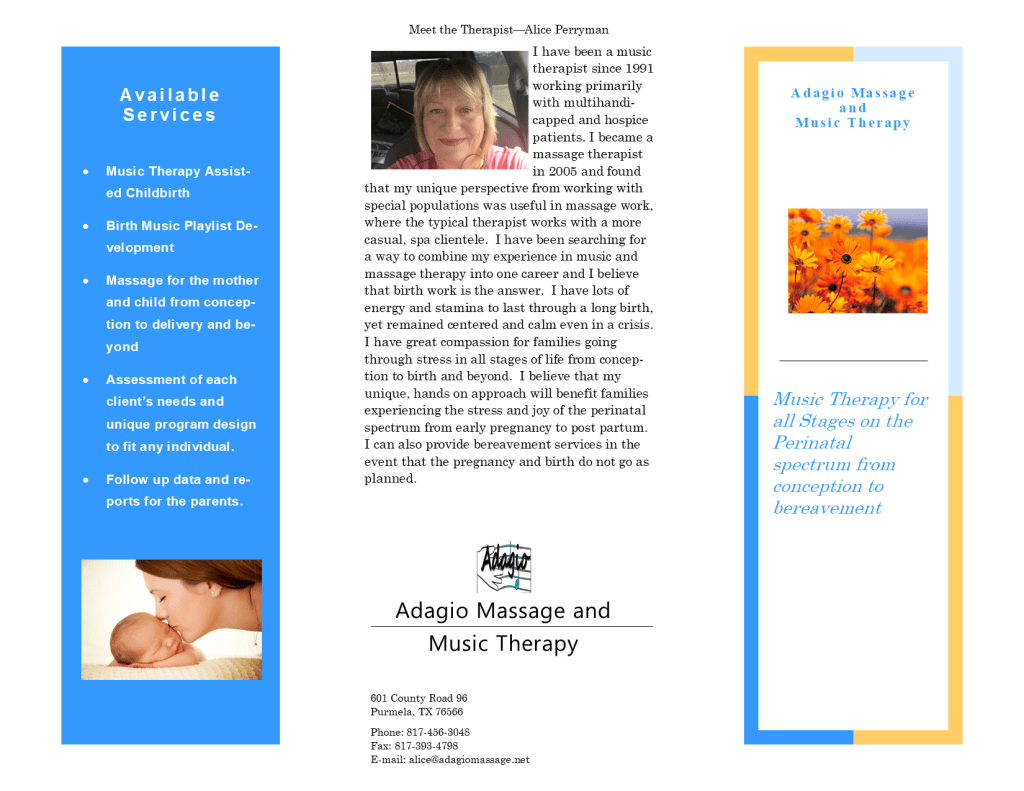
Below is my Music Therapy Assisted Child Birth brochure. I’m still working on a comprehensive brochure for massage therapy but many of the services are listed on my square appointments website with the link above.

HumanKind
Posted on May 29, 2020 Leave a Comment
This song came across my newsfeed from a memory last year and I thought it was pretty special considering our pandemic so I thought I would share it. Enjoy
Exciting Announcement
Posted on May 27, 2020 Leave a Comment
I’m so pleased and excited to announce that I am going to be renting a room for massage/music therapy in Burnet, TX starting June 15. I will finally have the opportunity to start doing birth music and massage therapy work and I am working to finish up my Doula certification with Stillbirthday. I will be at Support the Mama Midwifery Service.
More info to follow…
Operation Song
Posted on May 25, 2020 Leave a Comment
Found this on CBS this morning and wanted to follow up on the concept. I think it’s a fabulous Idea. I would love to see them pair up with music therapists to help the vets process the feelings that are writing about. Music Therapists have this unique training that song writers don’t have could add an additional layer to the song writing experience. Since the VA has music therapists it would be really cool to see them teamed up.
From the website:
Operation Song empowers veterans and their family members to tell their stories through the process of songwriting. Those we serve need no musical or writing skills, only a willingness to share their stories and, with the help of professional songwriters, transform them into song.
“Operation Song has changed my life, brought back something I had lost 40 years ago”
– Jimmy Ray Sells, Navy Veteran
Back to Practice
Posted on May 11, 2020 Leave a Comment
Back to Practice—Summary
https://www.abmp.com/back-to-practice/summary
Using COVID-19 best practice recommendations from the Centers for Disease Control and Prevention (CDC) and the World Health Organization (WHO), guidance from other health-care sectors, findings from the limited and preliminary research on the virus, and the most accurate updates we could gather from the quickly evolving science, we’ve compiled this document of practice protocols that seem most appropriate for practitioners who are choosing to move forward with reopening their businesses.
This document does not represent a recommendation from ABMP for reopening your practice, but rather gives our best guidance for when that time comes.
There Are No Guarantees
In lieu of a cure, vaccine, antibody tests, or other intervention for COVID-19, there is no way right now to venture back into practice without revised protocols to protect you and your clients. Even so, there is no guarantee that you or your clients will come away from your interactions unscathed.
Important Reopening Considerations
- You must be abiding by the guidelines and recommendations of your state and/or local governments, as well as your massage regulatory agencies regarding reopening your practice. If you live in a state that has ordered you to shut down your business and you are still seeing clients, you will not be covered by your professional liability insurance in case of an accident or claim. If you are working as an employee, consult with your employer to understand the precautions they are taking on behalf of you and your clients.
- Following CDC guidelines is imperative to offering the safest experience for your clients. Much of the information that follows draws from CDC guidelines, which are available for your personal reference at www.cdc.gov/coronavirus/2019-ncov/index.html.
- A likely requirement in any regulations or reopening plan will be the use of personal protective equipment (PPE), specifically face masks. We understand that PPE is scarce and any available supplies are being redirected—rightly so—to frontline workers and health assistance staff who are still operating without the proper supply of equipment they need to work safely. Diverting supplies for non-emergency equipment requests at this time would be dangerous and unethical. Consider other options for face coverings for you and your clients in the interim. We have an overview of PPE options at www.abmp.com/updates/blog-posts/use-personal-protective-equipment-ppe-massage-therapists.
What Your New Business Might Look Like When You Reopen
- Temper your expectations—it may be a while before you’re fully up and running again. Use this time to update cancellation policies, waiting room layouts, booking programs, and language changes for your website and materials.
- Come back slowly—see what challenges you encounter with the new working protocols and what areas to improve. Staggered appointment times and greater time necessary for cleaning protocols might mean you’ll need to rethink your daily schedule and the number of clients you can see. Think about your hours of operation.
- In accordance with extended shelter-in-place recommendations to protect our more vulnerable populations you may only be able to work with clients who are in lower risk categories for COVID-19 complications.
We understand there is a fine line between getting back to work and earning an income, and protecting the safety of you and your clients. For those thinking about going back to work we recommend the following to states and our members:
- Face masks be utilized in treatment rooms to help prevent the spread of COVID-19; we encourage that both the therapist and the client wear a face covering.
- Following stringent sanitation protocols between each client is critical. Use EPA-certified disinfectants on all surfaces, doorknobs, chairs, etc., that a client might have touched.
- Change all linens, fleece blankets, and perhaps your clothes between each client. Use gloves where practical.
- Stagger client appointments or text them when they can come in so there is no more than one client at a time in common areas. Make sure you have ample time to prepare for, and take care of, each client and your work area.
- Be transparent—in your reminder phone call, on your intake form, even when clients arrive for their appointment. Ask them: Have you had a fever in the last 24 hours of 100°F or above? Do you now, or have you recently had, any respiratory or flu symptoms, sore throat, or shortness of breath? Have you been in contact with anyone in the last 14 days who has been diagnosed with COVID-19 or has coronavirus-type symptoms? If they answer yes, then ask them to reschedule, without penalty.
- Live your words—do the same that you ask of your clients. Let them know how you are feeling, and err on the side of caution. They are just as concerned as you are.
- Set expectations for your client; let them know there is a “new” normal in your practice (e.g., limiting your “table talk”). Let them know safety is an important element of your therapy.
Music as Therapy
Posted on May 1, 2020 Leave a Comment
See link to video below.
https://wfaa.com/embeds/video/287-24554e83-384d-43e0-93aa-0d698f84d2d3/iframe?jwsource=cl
Author: Tashara ParkerPublished: 10:10 AM CDT May 1, 2020Updated: 10:11 AM CDT May 1, 2020
All over the world, many have been forced to put a pause on life. Music, in its many forms, continues to inspire and unite us as we deal with the COVID-19 pandemic.
It’s one element that a Fort Worth man needed to overcome his greatest challenge yet.
Since he was four years old, music has been a mainstay.
“My dad used to be in a band a long time ago, called Mcghee band,” said Fort Worth musician and producer, Derrick Mcghee. “Basically, I used to listen to him play drums when I was younger.”
Mcghee, known as “Dread Beatz” in the music world, never seemed to have any trouble finding his way around a drum set.
“I just picked it up and learned how to play,” he added.
While life’s challenges can find their way in, Mcghee often uses music to fine-tune the daily stressors of life.
His latest challenge though is one we’re all still learning about and would produce an entirely new soundtrack.
“I started feeling chills and I started having a fever,” he said, as COVID-19 started to invade his body.
“It’s basically like flu-like symptoms, all of a sudden I got a cough that was more like a pneumonia cough and basically it got worse and I felt like I couldn’t breathe,” he said.
After days of trying to shake-off symptoms at home, Mcghee and his wife made their way to the hospital
“Next thing you know, they just admitted me in the hospital,” said Mcghee.
He spent the next week in a hospital room surrounded by nurses and doctors.
During his stay, no outside visitors were allowed inside his hospital room, but he said he never felt alone.
“You know, I’ve heard about all these people dying with it [COVID-19] and I’m not ready to leave my family, I want to be here for them,” said Mcghee. “I prayed my way through the situation and He [God] pulled me through. He really did.”
So did the other mainstay in his life that he’s always leaned on.
“Music was all in my head the whole time I was laying in the bed, you know, even though I was sick, [there were] new tracks coming in my head,” Mcghee said.

